


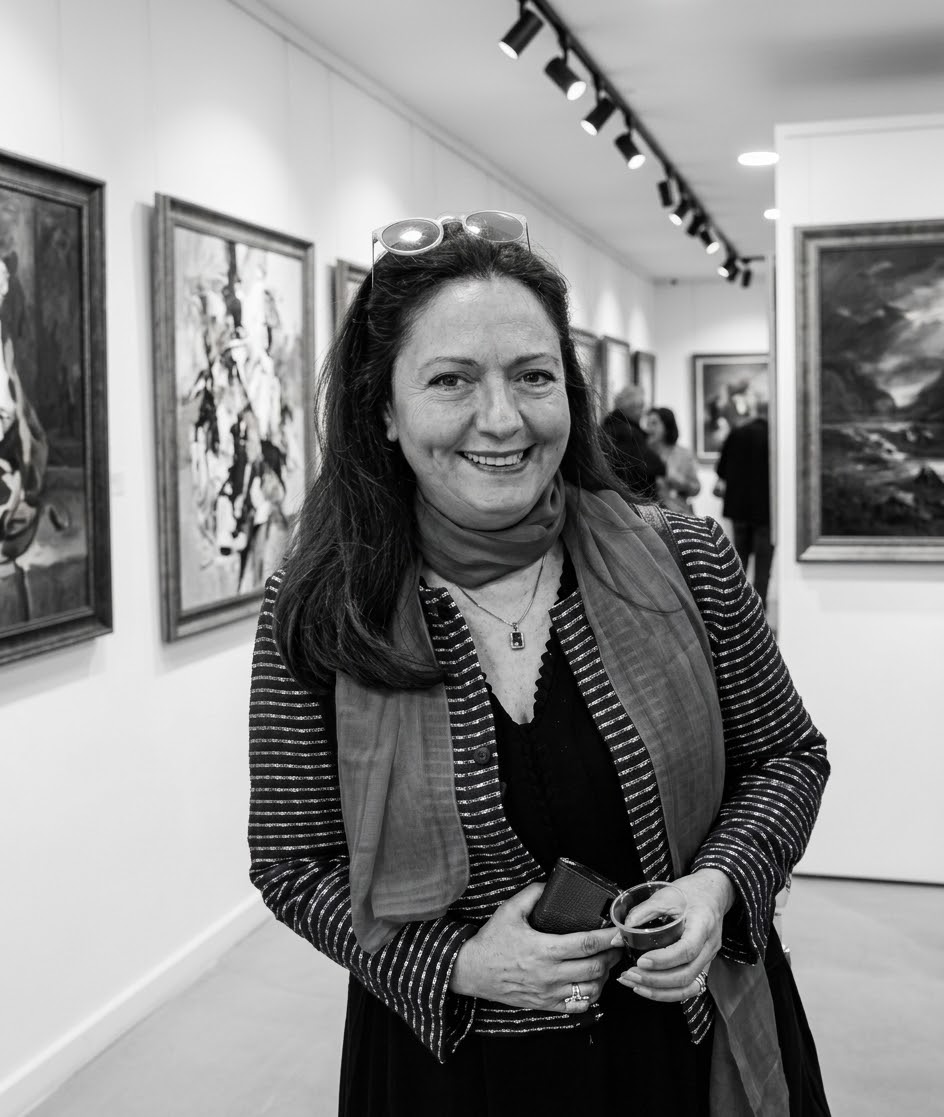
Nazan Tosun × Taylan Tosun
TT ART SPACE • Türkiye Culture Route Festival 2026
Working with micro-sand, glass mosaic, and natural stone for nearly a decade, Nazan Tosun speaks ahead of her first solo exhibition about her relationship with materials, the influence of her engineering background on her practice, her personal stories, and how works from different periods come together in this show.
How did you begin working with micro-sand? How did your relationship with assembling small pieces into a whole in mosaic develop, and how did the transition from glass to sand unfold?
When I first became interested in mosaic, what drew me in most was how tiny fragments gradually come together into a whole over time. Dedicating time to a surface piece by piece and watching each fragment slowly find its place brought me a deep sense of calm.
I first worked with glass mosaic — I also created an Atatürk portrait using this technique. You divide the face in the image into geometric pieces of different colours, make a template for each piece, transfer it onto glass, and cut them one by one. It requires immense precision and focus. The technical challenges of cutting and shaping glass led me to explore other materials, which is how I discovered micro-sand. Over time, sand stopped being merely an alternative material for me; it became a distinct creative field in which I invested long hours and developed my own working rhythm. I haven’t left glass behind either — I’m now looking forward to working with it more intensively again.
One of the things that surprises me most in these works is how extensive the preparation behind the finished image is. How does your process of creating a work with micro-sand unfold?
The aquarium sand I use starts out completely white. I don’t buy pre-coloured sand; I mix every shade myself and dye the sand batch by batch. In one work, for instance, I prepared thirteen different shades of orange just to achieve the volume and light gradation within the orange tones. After dyeing, I dry each batch individually — I use a hair dryer, because if you leave it to air-dry, the grains clump together. Then I arrange all the colours in front of me and place them onto the surface using different tweezers. From a distance, you only see the finished image, yet behind it lies a remarkably long process stretching from mixing colours and drying to shading and applying the work grain by grain.
I think your background in engineering is one of the most personal aspects of your practice. I’m curious how your relationship with drafting and geometry carries over into the work you make today.
My engineering background was largely focused on structural design. We worked with static and reinforced-concrete calculations, mathematics, and technical drafting. Before today’s software existed, we drew columns, beams, and blueprints mostly by hand. That instilled a strong drafting discipline and a habit of geometric thinking. I still feel its influence while creating; I can quickly visualise how to divide a form or where to cut glass to get the exact triangle, square, or strip I need. When it comes to proportion, planning, and how parts lock into a whole, my engineering instincts are always active.
Your body of work spans many visual languages — figurative, traditional, illustrative, and Pop Art–influenced. In some pieces, you also reinterpret existing, well-known, or personally inspiring visual compositions in micro-sand. What does reconstructing an image in a completely different material mean to you?
Modern lines, illustration, Pop Art, and geometric arrangements are visual worlds I feel close to. Sometimes I choose an existing image that moves me and rebuild it in micro-sand. What truly matters to me is how that image transforms through the texture of the sand and the discipline of the process. I love that the same material can yield such contrasting outcomes. In some works, tones must blend softly into one another; in graphic works, on the contrary, colour fields must sit side by side with razor-sharp, clean boundaries without bleeding. Even in areas that appear flat, you work with extreme care so not a single grain of another colour strays across a line. The fact that micro-sand can respond to both painterly and graphic languages is, for me, one of the greatest strengths of this technique.
Sessiz Mektuplar (Silent Letters) holds a special place in the selection for me as well; both its scale and the personal story it carries set it apart from the other works. What does this piece mean to you?
Roughly four years passed between the beginning and completion of Sessiz Mektuplar. During that time, there were long pauses when I had to step away from working, especially due to my husband’s illness and health challenges within our family. Over time, the piece became deeply personal. I came to identify myself with the woman in the composition, associated the large bird with my husband, and the other three birds with my children. The large bird came to embody my greatest wish for my husband’s recovery, while the other birds represented my children moving freely forward in their own lives. So the work is not simply a piece that took a long time to finish — it became a surface where four years of lived experience and emotion accumulated.
Being accepted into the Türkiye Culture Route Festival — and having this mark your very first solo exhibition — is an important milestone. Moreover, it is also the inaugural exhibition of TT ART SPACE. What does this beginning mean to you?
Until now, I have always participated in group exhibitions, symposiums, and collaborative projects; I had never held a solo exhibition. Being accepted into the Türkiye Culture Route Festival and presenting my first solo show within its programme truly thrilled me. The fact that TT ART SPACE is opening its doors for the very first time with this exhibition brings an added joy — having the space’s inaugural exhibition coincide with my first solo show feels deeply special. Works I created across many years will be seen together on their own, in dialogue within the same room, for the first time. I will be present at the gallery throughout the festival. During certain hours, I plan to continue working on site to show visitors how the sand is prepared and applied. Welcoming anyone curious about the process during those hours will make me very happy.
When working on the curatorial flow of this selection, I didn’t want to structure it as a traditional chronological retrospective. To me, what truly unites these works under one roof lies less in chronology than in the mode of making: assembling grains and fragments, and carrying a single material across different visual languages. That is why I conceived the exhibition through three unmarked sections. I wanted visitors to first encounter the works carrying your most intimate emotions, offering a closer glimpse into your inner world. The narrative then shifts toward more graphic and Pop Art–influenced pieces, where we see how micro-sand can create not only soft tonal transitions and detailed surfaces, but also crisp edges, bold colour fields, and a more direct visual language. In the final section, the gaze opens outward from the personal sphere, connecting with your geography and cultural surroundings through nature, Antalya, and Döşemealtı motifs. In this way, the exhibition traces an outward arc from the inner world to the possibilities of material, and from there to place and cultural memory. Looking at your own practice through this curatorial reading, what kind of whole do you see?
This approach feels much truer to me than simply placing the works in chronological order. Across different periods, I explored very different possibilities with the same material. The way a piece with dense tonal shifts and fine detail like Sessiz Mektuplar is executed is completely different from the crisp, bounded colour fields in the Pop Art works. Opening outward in the final section toward nature, the Mediterranean, works tied to Antalya, and Döşemealtı motifs reveals yet another facet of the practice. While making them, I never consciously planned three sections; yet seeing the works side by side today, I can perceive much more clearly how a single way of making can open into so many distinct visual languages over time.
The Döşemealtı carpet motif is one of the pieces in the selection that fascinates me most. Reinterpreting a carpet pattern — already built thread by thread — through grains of sand feels like a remarkably resonant encounter. How did this project come about? And considering it alongside Akdeniz’in Tılsımlı Şakayıkları, what role do Antalya and a sense of place play in your practice?
Initially, I had actually envisioned a much larger project around Döşemealtı carpets. For Antalya, Döşemealtı carpets are not merely a traditional craft; they are a symbolic heritage carrying the memory of Yörük culture, stories woven knot by knot, and the identity of the city into the present. Pursuing that depth, I visited the Antalya Provincial Directorate of Culture and Tourism and closely studied academic theses written at Akdeniz University and Süleyman Demirel University, which documented over sixty motifs. I then went to the Döşemealtı Municipality to meet and interview the master weavers and women who weave these carpets.
My first thought was to work these motifs in glass mosaic. Yet when I tried one of the motifs in micro-sand, I realised how naturally the texture of a woven rug resonates with the surface of sand. Focusing on just one section of the carpet, this piece was quite demanding in sand because of its fine lines and sharp geometry, yet it was also deeply rewarding. The meanings embedded in the motifs move me as well. That is why I very much want to expand this direction in the future — working with other motifs and even experimenting with three-dimensional surfaces that evoke the fold and drape of an actual carpet.
Akdeniz’in Tılsımlı Şakayıkları connects with this geography from another angle — through the peonies associated with Antalya and Mediterranean flora. Seeing these two works meet in the same selection creates a lovely passage for me, not only between traditional motifs and nature, but also between Antalya’s cultural heritage and its landscape.
While this exhibition looks back, I think it also offers glimpses into the future. Which materials and directions do you hope to explore further in your upcoming work?
I will certainly continue working with sand — it holds a truly special place in my art. At the same time, I want to return to glass. I have already gathered thirty different colours and tones of glass along with specialised cutting and shaping tools, and I’m preparing to work in a more comprehensive, dedicated studio space.
Natural stone also fascinates me. The softer, organic hues of seaside pebbles can give a piece the patina of an aged surface or an ancient fragment. Until now, human figures — especially women — have been central to my work. Moving forward, I would love to explore nature and landscape compositions, particularly through natural stone.
What would you most like visitors to carry with them about your work after leaving the exhibition?
Above all, I would like them to sense how delicate and patient a process working with micro-sand truly is. At earlier group exhibitions, visitors would pause in front of my pieces and ask, “How was this made? Do you pour the sand first and paint it afterward?” Sometimes they would ask to meet the artist just to share their appreciation. Even fellow glass mosaic artists who follow my work closely remark on how uniquely demanding the patience and precision of sand work are.
Building soft tonal transitions in one piece and forming an immaculate boundary between two colours without letting them mingle in another each bring their own challenge. I want visitors to see not only the finished image, but how that image transforms grain by grain into a whole.